Visual Strategy Map
How Smart-HODL Works
Our proprietary model is engineered for high-performance automation, leveraging market volatility to build long-term wealth while mitigating downside risk.
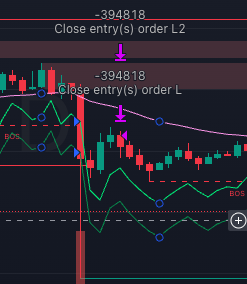
Strategic Entry
Our “Elasticity Model” identifies price exhaustion. The bot calculates tactical entry points to maximize accumulation at market bottoms.
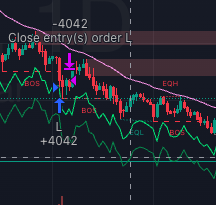
Bear Advantage
Capturing panic sell-offs and rebalancing during corrective “pushback” rallies to maintain growth even in broader downtrends.
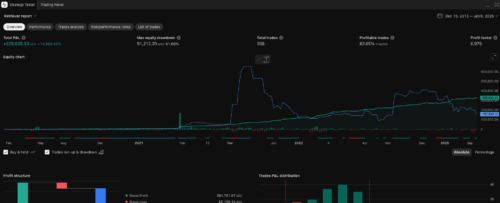
Compounded Alpha
Systematically reinvesting into new Elasticity windows allows for exponential outperformance over static Buy & Hold strategies.
The Mechanics: Rules-Based Automation
The Smart-HODL algorithm operates as a non-discretionary execution tool based on a fixed mathematical framework. Unlike “black-box” systems, its logic is rooted in objective price-action data and our proprietary Elasticity Model.
1. Entry Logic (The Elasticity Model)
The strategy utilizes the Elasticity Model on a 1-Day timeframe to identify price exhaustion. It monitors the “stretch” between the current market price and a long-term moving average (SMA). Entry orders are automatically triggered when the model identifies a tactical value opportunity based on a specific volatility multiplier.
- Dual-Tranche Entry: The algorithm can execute up to two distinct entry points per bar (Standard and Extra-Stretch), allowing for more efficient accumulation during rapid price drops.
- Controlled Pyramiding: The system is capped at a maximum of 3 consecutive entry days (max. 6 total tranches), ensuring a disciplined DCA process.
2. Exit Logic (Cycle Completion)
The exit strategy is designed for clean cycle completion and capital rotation. The software monitors the relationship between daily price closes and the position’s average entry price.
- Break-even & Profit Targets: Trades are programmed to close once the market price moves above the weighted average entry price plus a user-defined minimum profit buffer.
By using this transparent, rules-based approach, Smart-HODL removes human emotion and provides a consistent technical bridge between the user’s exchange account and quantitative trading principles.
Core Algorithm Principles: The Science of Smart-HODL
The Smart-HODL algorithm is engineered for resilience, navigating the inherent volatility of digital assets by prioritizing capital protection and strategic accumulation. Unlike traditional “Buy & Hold” strategies that remain fully exposed during market downturns, Smart-HODL utilizes a reactive, multi-layered entry system to optimize long-term growth.
1. Strategic Entry Levels: The “Elasticity” Model
Our algorithm operates on a “mean-reversion” philosophy. It treats market price action like a stretched elastic band; the further the price deviates downward from its established average, the stronger the probability of a corrective bounce.
-
A.
Dynamic Support Monitoring: The system constantly calculates baseline market stability based on 100-day price trends.
-
B.
Layered Acquisition: Smart-HODL calculates two distinct “Elasticity” tiers to avoid entering positions during minor fluctuations.
-
C.
Volatile Opportunity: During extreme market stress, the algorithm can open up to two separate long tranches within a single day, capturing the velocity of rapid “flash crashes”.
2. Navigating Volatility: The Pushback Effect
While a typical investor sees a bear market as a loss, our algorithm identifies it as a sequence of technical “Elasticity” events.
-
A.
Fast-Movement Filtration: The system ignores market noise and only triggers during significant downward deviations.
-
B.
Mean Reversion Liquidation: Historically, large drops lead to a “pushback” or relief rally. Smart-HODL enters during the deviation and automates exits during these rallies to secure capital.
3. Optimization via Algorithmic Compounding
The ultimate goal is superior risk-adjusted returns by automating tactical entries to achieve two critical results:
-
A.
Drawdown Mitigation: By only entering during specific Elasticity windows, the algorithm significantly reduces capital exposure compared to static holding.
-
B.
The Compounding Engine: Securing gains into stablecoins during rallies allows for larger reinvestment into the next value window, accelerating long-term growth.
REGULATORY DISCLOSURE: Smart-HODL is a software-as-a-service (SaaS) provider. The “Elasticity Model” is a fixed, non-discretionary mathematical algorithm. The provider does not have discretionary authority over user funds, does not provide individualized investment advice, and does not act as a custodian. All trade executions are initiated by the software logic on the user’s behalf through encrypted API keys. Past performance, including backtested results, is not indicative of future success.